
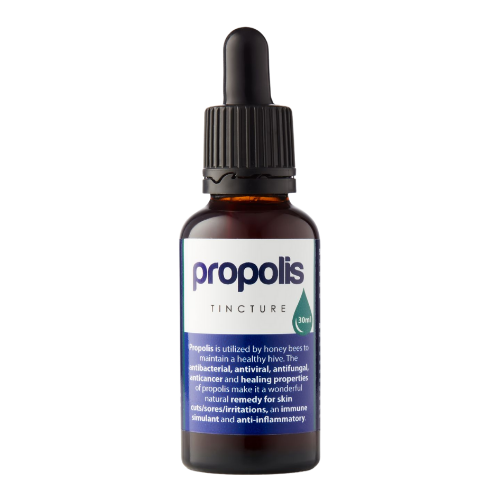
Propolis is a natural substance collected and used by honey bees to maintain a healthy hive, as a waterproofing agent and barrier against yeasts and moulds, bacteria, and viruses (Bachevski et al. 2020). It consists of pollen, resins, waxes and magnitudes of flavonoids (Grange & Davey. 1990). Propolis has been used by humans for thousands of years for its medicinal properties, and by the ancient Egyptians for embalming (Kuropatnicki et al. 2013).
The ingredients of propolis possess antimicrobial, anti-neoplastic, anti-inflammatory, antioxidant, hepatoprotective, cariostatic, and immunostimulatory activity (Bachevski et al. 2020; Kurek-Górecka et al. 2020). However, propolis cannot be used in its raw form (Figure 1) and must be purified by extraction with solvents prior to use in medicine.
At Nanomedsa the active ingredients are isolated from the raw propolis by alcohol extraction. Raw propolis is frozen and ground, the fine powder is then sonicated in ethanol where after it is centrifuged and filtered. The concentration of total polyphenols is adjusted to ≥ 10ml/ml and the end product is bottled.
The antibacterial (Grange & Davey. 1990; Bankova et al. 1995), antifungal (Dalben et al. 2011), anticancer (Ishida et al. 2018; Sawicka et al. 2012) and healing (Ramos & Marinda. 2007) properties of propolis are being extensively studied in modern science. Propolis has also been demonstrated to possess a potent and broad-spectrum antiviral (Pobiega et al. 2017) activity against a diverse panel of viruses such as HSV-1, HSV-2, Influenza virus type A and B, Parainfluenza virus, Adenovirus, HIV, infectious bursal disease virus, and avian reovirus, Newcastle virus disease, bovine rotavirus, pseudorabies virus, feline calicivirus, canine adenovirus type 2, and bovine viral diarrhea virus (Bachevski et al. 2020).
Proposed mechanisms of antiviral activity include inhibition of virus entry into the cells, and disruption of the viral replication machinery (Bachevski et al. 2020). In addition to its effect on virus multiplication, propolis was also found to exert a virucidal action on the enveloped viruses (Kurek-Górecka et al. 2020). Data now also support the idea that caffeic acid phenethyl ester, one of the most important constituents of propolis, can be useful as an agent to stop or inhibit coronavirus-induced fibrosis in the lungs(Maruta & He. 2020). Berretta et al. (2020) writes that propolis has properties that are particularly relevant to SARS-CoV-2 infection, such as immune system fortification, reduced viral replication, and anti-inflammatory action.
Bachevski et al. 2020, therefore, suggests that propolis may represent a low-cost treatment option against SARS-CoV-2. Considering the mode of transmission of SARS-CoV-2, effective oral hygiene may be beneficial to decrease the risk of transmission. In addition, gargling is deemed to bring about favourable effects. Although propolis belongs to the safest natural remedies, on rare occasions, adverse effects of propolis or its constituents are to be expected, especially allergic reactions. Therefore, hypersensitivity reactions should be taken into account.
The dosage described here does not originate from scientific research and is a traditional folk remedy. Shake the bottle well before use. Add 18-20 drops of Nanomedsa’s propolis tincture to 100 ml water, gargle and swallow. Do this twice daily
Sources:
- Bachevski, D., Damevska, K., Simeonovski, V., Dimova, M., 2020. Back to the basics: Propolis and COVID-19. Dermatol Ther. 33:e13780
- Bankova, V., Christov, R., Kujumgiev, A., Marcuccic M.C., Popov, S. Chemical Composition and Antibacterial Activity of Brazilian Propolis. 1995. Z Naturforsch. 50c:167-172
- Berretta, A.A., Silveira, M.A.D., Capcha, J.M.C., De Jong, D., 2020. Propolis and its potential against SARS-CoV-2 infection mechanisms and COVID-19 disease
Running title: Propolis against SARS-CoV-2 infection and COVID-19. Pharmacother. 131: 110622 - Dalben Dota, K.F., Lopes Consolaro, M.E., Svidzinski, T.I.E., Bruschi, M.L. 2011. Antifungal Activity of Brazilian PropolisMicroparticles against Yeasts Isolated from Vulvovaginal Candidiasis. Evid Based Complement Alternat Med. Article ID 201953, doi:10.1093/ecam/neq029
- Grange, J.M., Davey, R.W. 1990. Antibacterial properties of propolis (bee glue). Royal Soc. Med. 83:159-160
- Ishida, Y., Gao, R., Shah, N., Bhargava, P., Furune, T., Kaul, S.C., Terao, K., Wadhwa, R. 2018. Anticancer Activity in Honeybee Propolis: Functional Insights to the Role of Caffeic Acid Phenethyl Ester and Its Complex With γ-Cyclodextrin. Integr Cancer Ther. 17:867–873
- Kurek-Górecka, A., Górecki, M., Rzepecka-Stojko, A., Balwierz, R., Stojko, J., 2020. Bee Products in Dermatology and Skin Care. Molecules. 25:556
- Kuropatnicki, A.K., Szliszka, E., Krol, W. 2013. Historical Aspects of Propolis Research in Modern Times. Evid Based Complement Alternat Med. Article ID 964149, doi: 10.1155/2013/964149
- Maruta, H., He H. PAK1-blockers: potential therapeutics against COVID-19. 2020. Med Drug Discov. 6:100039.
- Pobiega, K., Gniewosz, M., Kraśniewska, K. 2017. Antimicrobial and antiviral properties of different types of propolis. Zeszyty Problemowe Postępów Nauk Rolniczych. 589:69-79
- Ramos, A.F.N., Marinda, J.L. 2007. Propolis: A review of its anti-inflamitory and healing actions. Anim. Toxins incl. Trop. Dis.13:697-710
- Sawicka, D., Car, H., Borawska, M.H., Nikliński, J. 2012. The anticancer activity of propolis. Folia Histochem. Cytobiol. 50:25–37