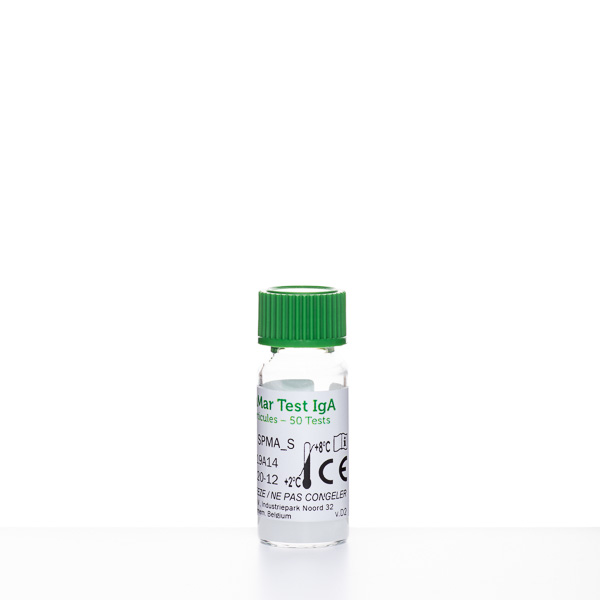
SpermMar Test IgA
Test for the detection of anti-sperm antibodies
SpermMar Test IgA and SpermMar Test IgG are rapid, easy-to-use tests for the detection of anti-sperm antibodies in semen and serum.
Anti sperm antibodies (ASA) are produced when the blood-testis barrier is disrupted by obstruction, infection or traumatism. Immunoglobulines of the IgG class are usually present in both serum and semen, and the IgG antibodies attach to the spermatozoa. ASA of the IgA class are secreted by the accessory sex glands and are found in semen only. ASA of the IgG class may be detected in seminal plasma, but there is usually no free IgA in seminal plasma. Anti sperm antibodies of the IgA class almost never occur without IgG antibodies.
When more than 40% of motile spermatozoa present ASA of the IgG class, complementary testing for IgA antibodies is advisable
The immunological factor reduces the probability of spontaneous conception, and this is particularly true when ASA of the IgA class are also present.
SpermMar Test IgA has a 12 month shelf life from production date. Information about the composition of the product can be found in the material safety data sheet.
Regulatory
- Europe: CE-marked – USA: registered – Canada: Health Canada licence
- Brazil: registered – Australia: registered
Product codes
SPMA_S : SpermMar Test IgA – Single kit – 50 tests
SPMA_C : SpermMar Test IgA – Complete kit – 50 tests
Al-Dujaily S.S., Chakir W.K., Hantoosh S.F., Direct Antisperm Antibody Examination of Infertile Men, Global Journal of Medical Research (2012),Vol.12,No.3
Ali N.H., Celiac Disease Occurence with Autoimmune Infertility in Infertile Men, Fam Med Med Sci Res (2016),Vol.5,No.4
Depuydt C.E., Bosmans E., Zalata A., et al., The Relation Between Reactive Oxygen Species and Cytokines in Andrological Patients With or Without Male Accesory Gland Infection, Journal of Andrology (1996),Vol.17,No.6,pp.699-707
Depuydt C.E., De Potter C.R., Zalata A., et al., Levels of Hepatocyte Growth Factor/Scatter Factor (HGF/SF) in Seminal Plasma of Patients With Andrological Diseases, Journal of Andrology (1998),Vol.19,No.2,pp.175-182
Garolla A., Pizzol D., Bertoldo A., et al., Association, prevalence, and clearance of human papillomavirus and antisperm antibodies in infected semen samples from infertile patients, Fertility and Sterility (2013),Vol.99,No.1,pp.125-131
Hadinedoushan H., Ghafourzadeh M., A survey of anti-sperm antibodies in infertile couples, Iranian Journal of Reproductive Medicine (2007),Vol.5,No.1,pp.39-40
Hussein T.M., Elneily D., Eid A.A., Abou-ElKhier H., Assessment of antisperm antibodies in a sample of Egyptian patients with hepatitis C virus infection, Andrologia (2017),Vol.49,No.e12664
Laudat A., Burc-Struxiano L., Is Absence of Spontaneous Agglutinates of Spermatozoa in Semen a Reliable Indicator of Non-Autosensization against Human Sperm Antigens?, Open Access Library Journal (2016),Vol.3,No.e2978
Marconi M., Nowotny A., Pantke P., et al., Antisperm antibodies detected by mixed agglutination reaction and immunobead test are not associated with chronic inflammation and infection of the seminal tract, Andrologia (2008),Vol.40,pp.227-234
Marconi M., Pilatz A., Wagenlehner F., et al., Are Antisperm Antibodies Really Associated with Proven Chronic Inflammatory and Infectious Diseases of the Male Reproductive Tract?, European Urology (2009),Vol.56,pp.708-715
Ombelet W., Vandeput H., Janssen M., et al., Treatment of male infertility due to sperm surface antibodies: IUI or IVF?, Human Reproduction (1997),Vol.12,No.6,pp.1165-1170
Poppe K., Glinoer D., Tournaye H., et al., Is systematic screening for thyroid disorders indicated in subfertile men?, European Journal of Endocrinology (2006),Vol.154,pp.363-366
Tennakoon V., Weerasekera DS., Yasawardene SG., Successful pregnancy outcomes following in-vitro fertilization in infertile couples with high levels of antisperm antibodies, Sri Lanka Journal of Obstetrics and Gynaecology (2010),Vol.32,pp.47-48
Tennakoon V., Yasawardene S.G., Weerasekera D.S., Possible risk factors for the formation of antisperm antibodies in a subfertile population, Sri Lanka Journal of Obstetrics and Gynaecology (2011),Vol.33,pp.12-19
Comhaire F.H., Mahmoud A.M.A., Depuydt C.E., et al., Mechanisms and effect of male genital tract infection on sperm quality and fertilizing potential: the andrologist’s viewpoint, Human Reproduction Update (1999),Vol.5,No.5,pp.393-398
Djaladat H., Mehrsai A., Rezazade M., et al., Varicocele and Antisperm Antibody: Fact or Fiction?, Southern Medical Journal (2006),Vol.99,No.1,pp.44-48
Francavilla F., Santucci R., Barbonetti A., Francavilla S., Naturally-occuring antisperm antibodies in men: interference with fertility and clinical implications. An update., Fronties in Bioscience (2007),Vol.12,No.May,pp.2890-2911
Hinting A., Vermeulen L., Comhaire F., The indirect mixed antiglobulin reaction test using a commercially available kit for the detection of antisperm antibodies in serum, Fertility and Sterility (1988),Vol.49,No.6,pp.1039-1044
Hossain A., Islam N., Schultz N., et al., Evidence of a Relationship Between Age of the Infertile Patient and the Prevalence of Antisperm Antibody (ASA)., Fertility and Sterility (2008),Vol.84,No.S1,pp.S457
Kamieniczna M., Domagała A., Kurpisz M., The frequency of antisperm antibodies in infertle couples – a Polish pilot study, Medical Science Monitor (2003),Vol.9,No.4,pp.194-201
Kendirci M., Hellstrom W.J.G., Antisperm Antibodies and Varicocele., Southern Medical Journal (2006),Vol.99,No.1,pp.13-15
Lähteenmäki A., In-vitro fertilization in the presence of antisperm antibodies detected by the mixed antiglobulin reaction (MAR) an the tray agglutination test (TAT), Human Reproduction (1993),Vol.8,No.1,pp.84-88
Lombardo F., Gandini L., Dondero F., Lenzi A., Immunology and immunopathology of the male genital tract. Antisperm immunity in natural and assisted reproduction, Human Reproduction Update (2001),Vol.7,No.5,pp.450-456
Lwaleed B., Greenfield R.S., Birch B.R., Cooper A.J., Does human semen contain a functional haemostatic system? A possible role for Tissue Factor Pathway Inhibitor in fertility through semen liquefaction, Thromb Haemost (2005),Vol.93,No.5,pp.847-852
Mahmoud A., Comhaire F., DEBATE Antisperm antibodies: Use of the mixed agglutination reaction (MAR) test using latex beads, Human Reproduction (2000),Vol.15,No.2,pp.231-233
Räsänen M., Saarikoski S., Penttilä I., Agrawel Y.P, A flow cytometric study on the effect of low dose cyclic prednisole treatment on sperm-bound antibody levels, Human Reproduction (1994),Vol.9,No.5,pp.889-893
Räsänen M.L., Havatta O.L., Penttila I.M., Agrawal Y.P., Detection and quantitation of sperm-bound antibodies by flow cytometry of human semen , Journal of Andrology (1992),Vol.13,No.1,pp.55-64
Rajah S.V., Parslow J.M., Howell R.J.S., Hendry W.F., Comparison of mixed antiglobulin reaction and direct immunobead test for detection of sperm-bound antibodies in subfertile males, Fertility and Sterility (1992),Vol.57,No.6,pp.1300-1303
Verheyen G., Tournaye H., Laurier K., et al., Auto-controlled study on in-vitro fertilization performance with ‘antibody-free’ spermatozoa selected by immunobead adsorption from semen of patients with anti-sperm antibodies, Human Reproduction (1994),Vol.9,No.6,pp.1119-1126